

Discover the secrets to making AI text resonate with a human touch.
Introduction
With the rapid advancement of AI, the world of content creation is undergoing a significant transformation. AI-generated text, once a mere concept, is now a reality, playing a pivotal role in various industries, from marketing to customer support. However, while AI can mimic human writing, it often lacks the nuanced touch and emotional depth that characterize genuinely human writing.
This guide delves into the essential techniques for humanizing AI-generated text, transforming it from mechanical to engaging, and from generic to personalized. Whether you're a content creator, marketer, or just AI-curious, you'll find valuable insights on making your AI-generated content more relatable and authentic.
The art of humanizing AI text lies not just in altering words, but in infusing the writing with the essence of human experience.
In the following sections, we'll explore the nature of AI-generated text, introduce a step-by-step process for humanizing it, highlight the tools that can assist in this endeavor, and discuss how to make ai writing undetectable.
Understanding the Basics of AI-Generated Text
At its core, AI-generated text is the product of machine learning algorithms, specifically natural language processing (NLP) models. These models are trained on vast datasets of human-written text, learning patterns, structures, and nuances of language. By analyzing this data, AI can generate text that mimics human writing styles.
Common characteristics of AI writing often include:
Structure: AI tends to follow standard grammatical rules with a clear beginning, middle, and end.
Tone: The tone of AI writing can vary based on its training, but it often lacks the subtle emotional variances present in human writing.
Vocabulary: AI-generated text often uses a diverse vocabulary but may lack the context-specific nuances that human writers employ.
Despite its advanced capabilities, AI-generated text often requires humanization. This is because AI, while proficient in language structure, cannot fully replicate the depth of human experience and emotional subtlety. Humanization enhances the relatability and authenticity of the text, transforming it from a mere arrangement of words into a narrative that resonates with human readers. Integrating human elements into AI text ensures that it connects with readers on a more personal and engaging level, crucial for effective communication in any form of writing.
The Humanization Process
The process of humanizing AI text involves a series of steps designed to infuse the text with human qualities that AI alone cannot replicate. This process is essential for creating content that is not only coherent and grammatically correct but also resonates with human readers on a deeper, more emotional level.
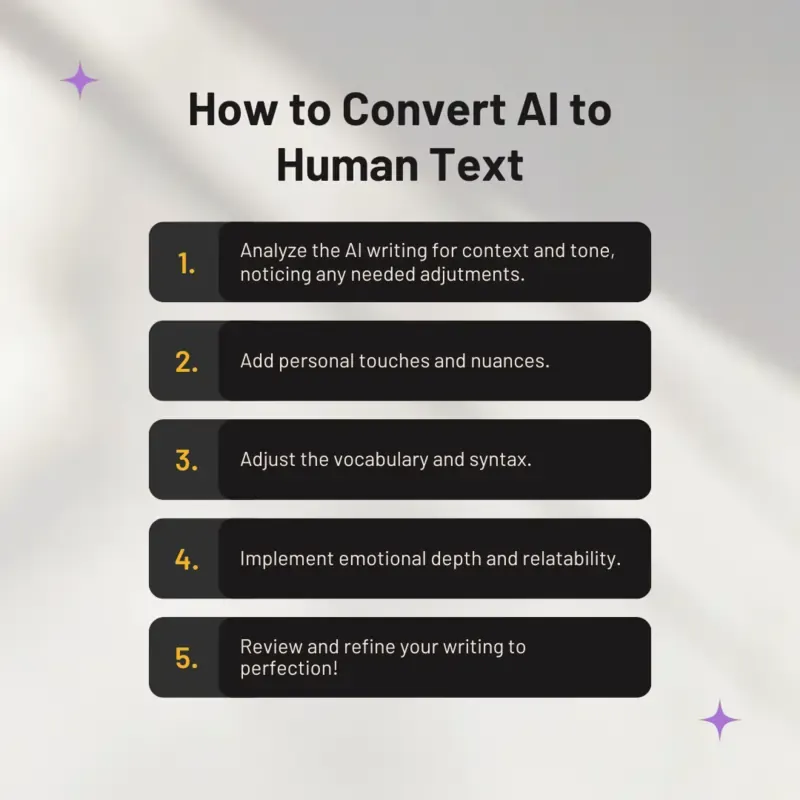
Step-by-Step Guide on Converting AI to Human Text
Step 1: Reading for Context and Tone
Begin by thoroughly reading the AI-generated text to understand its overall context and tone. Look for areas where the tone may not align perfectly with the intended message or audience, noting any adjustments needed.
Step 2: Adding Personal Touches and Nuances
Inject personal touches and nuanced elements that reflect human experiences and emotions. This could involve incorporating idiomatic expressions, anecdotes, or a conversational style that makes the text more relatable.
Step 3: Adjusting Vocabulary and Syntax
Alter the vocabulary and syntax to better suit the intended audience. This step involves refining word choices for appropriateness and impact, and adjusting sentence structures to enhance readability and flow.
Step 4: Implementing Emotional Depth and Relatability
Enhance the text with emotional depth and relatability. This can be achieved by adding elements that evoke empathy, humor, or other emotions relevant to the context of the content.
Step 5: Final Review and Polishing
The final step is a comprehensive review and polishing of the text. This is where the human writer fine-tunes the content, ensuring it reflects a natural, human tone and style, free from any lingering AI artifacts.
Tools and Technologies
In the journey of humanizing AI-generated text, various tools and technologies play a pivotal role. Among these, platforms like WriteHuman stand out for their efficiency and effectiveness in transforming AI text into human-like content. WriteHuman serves as the ultimate AI word humanizer.
Overview of AI humanizers like WriteHuman
WriteHuman and similar platforms are designed to convert AI to human text and apply a series of enhancements to make it more human-like. These tools utilize advanced algorithms to detect and modify elements in the text that are typically indicative of AI, such as repetitive phrasing, unusual word choices, or lack of emotional depth.
How AI humanizers Work
These tools work by employing a combination of natural language processing techniques and human-like writing models. They analyze the text for structure, tone, and context, making adjustments to emulate the nuances of human writing. This process includes refining vocabulary, adding stylistic elements, and enhancing emotional resonance. The ultimate goal of humanizer tools is to serve as a powerful human ChatGPT converter.
The Role of Tools in Simplifying the Process
Tools like WriteHuman significantly simplify the humanization process. By automating the initial phases of text refinement, they allow content creators to focus on higher-level enhancements and personal touches. This not only saves time but also ensures a consistent baseline quality in the humanized text.
Benefits of Using Such Tools Over Manual Editing
Compared to manual editing, these tools offer several benefits:
Efficiency: They drastically reduce the time and effort required to transform AI text into human-like content.
Consistency: These tools maintain a consistent level of quality in humanization, which can be challenging to achieve manually.
Scalability: For large volumes of content, these tools provide a scalable solution that manual editing cannot match.
Overall, while manual editing has its place, the use of specialized tools like WriteHuman offers a more efficient, consistent, and scalable approach to humanizing AI-generated text.
Practical Applications and Examples
The humanization of AI-generated text finds its significance in a variety of real-world scenarios. The ability to transform AI writing into something that resonates on a human level is particularly crucial in areas such as marketing, customer service, and storytelling. Let's explore some of these applications.
Marketing
In marketing, the human touch in content can be the difference between engaging a potential customer and losing their interest. Humanized text feels more personal, trustworthy, and relatable, making it a powerful tool for crafting compelling marketing messages and campaigns.
Customer Service
Customer service interactions benefit greatly from humanization. AI-generated responses, when humanized, can provide customers with the feeling of a personalized and empathetic interaction, enhancing customer satisfaction and loyalty.
Storytelling
Storytelling, whether in literature, journalism, or other forms, relies heavily on emotional depth and relatability. Humanizing AI text ensures that they capture the essence of human experience, making them more engaging and impactful for the audience.
These examples illustrate just a few of the many scenarios where humanizing AI text plays a crucial role. By adding the human element to AI-generated content, it's possible to create a more meaningful and effective connection with the intended audience.
Best Practices and Tips
Effectively humanizing AI-generated text is both an art and a science. To achieve the best results, it's important to follow certain best practices and be aware of common pitfalls. Here are some expert tips to guide you through the process.
Expert Tips for Effectively Humanizing AI Text
Understand the Audience: Tailor the text to the preferences and expectations of your target audience. This involves using the appropriate tone, style, and vocabulary.
Emphasize Contextual Relevance: Ensure that the text is contextually relevant and aligns with the overall message or theme.
Inject Personality: Add personality to the text to make it more engaging and relatable. This could involve humor, storytelling elements, or a conversational tone.
Review and Revise: Always review the humanized text to catch any inconsistencies or areas that need further refinement.
Common Pitfalls to Avoid
Over-Editing: Avoid over-editing the text to the point where it loses its original intent or becomes too convoluted.
Ignoring the AI's Strengths: Leverage the strengths of AI, such as data accuracy and logical structuring, instead of completely overhauling its output.
Neglecting the Human Touch: Don't forget to add the human element, which is essential for creating a connection with the audience.
Maintaining a Balance Between AI Writing and Human Writing
Maintaining a balance between leveraging AI's efficiency and ensuring human authenticity is crucial. Utilize AI to handle the bulk of content generation, but always infuse the final output with human insights, emotions, and creativity. This balance ensures that the content benefits from the efficiency of AI while retaining the warmth and relatability of human writing.
Conclusion
Throughout this guide, we've explored the intricate process of humanizing AI-generated text. From understanding the basics of how AI creates text to delving into the specific steps of the humanization process, we've seen the vital role that human touch plays in transforming AI content. Tools and technologies like WriteHuman simplify this process, allowing for efficient and effective humanization.
The practical applications of humanized AI text in marketing, customer service, storytelling, and more, demonstrate its wide-reaching impact. By following the best practices and avoiding common pitfalls, we can harness the power of AI while maintaining the authenticity and relatability that only human writing can provide.
We encourage you to embrace the art of AI text humanization in your respective fields. Whether you're a content creator, marketer, or someone interested in the intersection of technology and language, the potential of humanized AI text is vast and largely untapped.
We invite you to try out the process of humanizing AI-generated text. Experiment with tools like WriteHuman, and discover how they can elevate your AI content to new heights of engagement and authenticity. Embrace the future of writing, where AI efficiency and human creativity combine to create truly compelling content. Convert AI to human text with WriteHuman.
FAQ
How Can I Humanize ChatGPT Text?
Humanizing ChatGPT text involves several steps. Start by reading the text to understand its context and tone. Then, add personal touches and nuances to make it sound more natural and less formal. Adjust the vocabulary and syntax to suit your audience, and infuse emotional depth to make it more relatable. Finally, review and refine the text to ensure it aligns with human writing styles. Tools like WriteHuman can also assist in this process, automating some of these steps for efficiency.
Can Humans Recognize ChatGPT's AI-Generated Text?
Yes, humans can often recognize ChatGPT's AI-generated text, especially if they are familiar with common characteristics of AI writing. These may include a certain formality in tone, structured and consistent grammar, and sometimes a lack of nuanced emotional expressions or personal anecdotes. However, with advancements in AI and the use of humanization tools, distinguishing AI-generated text from human writing is becoming increasingly challenging.
How to Make AI Writing Undetectable
Making AI writing undetectable involves a few key strategies:
Emphasize Natural Language: Modify the AI-generated text to use more conversational and natural language. This includes using colloquialisms and phrases that are commonly found in everyday speech.
Introduce Variability: Add variability in sentence structure and word choice. AI tends to follow certain patterns, so breaking these can make the text seem more human-written.
Inject Personality and Emotion: Incorporate personal anecdotes, opinions, and emotional expressions. AI often lacks the depth of human experience, so adding these elements can make a big difference.
Customize for the Audience: Tailor the text to the specific audience, including their interests, language style, and cultural references, which AI might not automatically consider.
Review and Revise: Carefully review and manually edit the text. This step is crucial for catching and changing any elements that might clearly indicate AI authorship.
Tools like WriteHuman can assist in this process by automatically applying some of these strategies, but a final human review is often necessary for the best results.